The paintings of Mirjam Vreeswijk and Koos de Vries feel like film scenes, with the artists playing the leading roles. Mirjam Vreeswijk's images are alienating. She is a prop in staged worlds that play with recognition and alienation. Koos de Vries is the B-actor in scenes in which he mocks himself, yet with serious undertones of art-historical references and societal criticism.
Mirjam Vreeswijk's (NL, 1997) new series of paintings was created during a period of change and loss. In response, she placed herself at the centre of her paintings. Not to find herself, but to construct a world in which to temporarily reside.
Like earlier series, her painted worlds consist of sets. Sometimes literally, by depicting fragile, self-built settings made of cardboard. Everything in this temporary world can shift or collapse with a single movement. Here, her face also becomes a piece of scenery. It can be seen underwater, behind plastic, in reflections, as a doubling or as an ornament.
Some works remain deliberately distant, others come closer. In the painting Press Continue, a portrait of the artist with her dog Puck, they move together through an unclear, swampy landscape. The setting feels like a digital game environment, a side quest with no end goal. As if the game, as a metaphor for life, has been paused for a moment and is now continuing.
We see glamour, smooth surfaces, theatrical lighting, and a 90s-style seduction in her work. The beauty in these images is artificial and constructed, as a way of gaining control. The world she builds is controlled and orderly, but not stable. There is a lot of fluidity, water, shine, soft transitions, and round shapes. Everything seems to be in motion, without arriving anywhere.
Koos de Vries (NL, 1993) also created self-portraits exclusively for this exhibition. With the acting talent of a show wrestler, he plays the leading role in his own paintings. In them, he seeks a meaningful interaction between drama, self-mockery and humour. Shame is the main motivation for the creation of his subjects. His disarming honesty has a sobering effect in a world full of digital self-glorification.
De Vries' reflections on excessive drinking, night-time gaming and stupid comments are executed in oil paint. The classical medium and contemporary subjects form an interesting contrast, which is further enhanced by the art-historical references that the painter incorporates into his work. He refers to religious and mythological painters such as Pieter Paul Rubens, Jacob Cornelisz - van Oostsanen and Masoline di Panicale. Their sacred images form a grand compositional basis for the artist's concerns. But he also refers to the work of these masters in terms of content. For example, we see De Vries as a contemporary Jesus protecting himself with sunglasses from the bright light of the Stigmata.
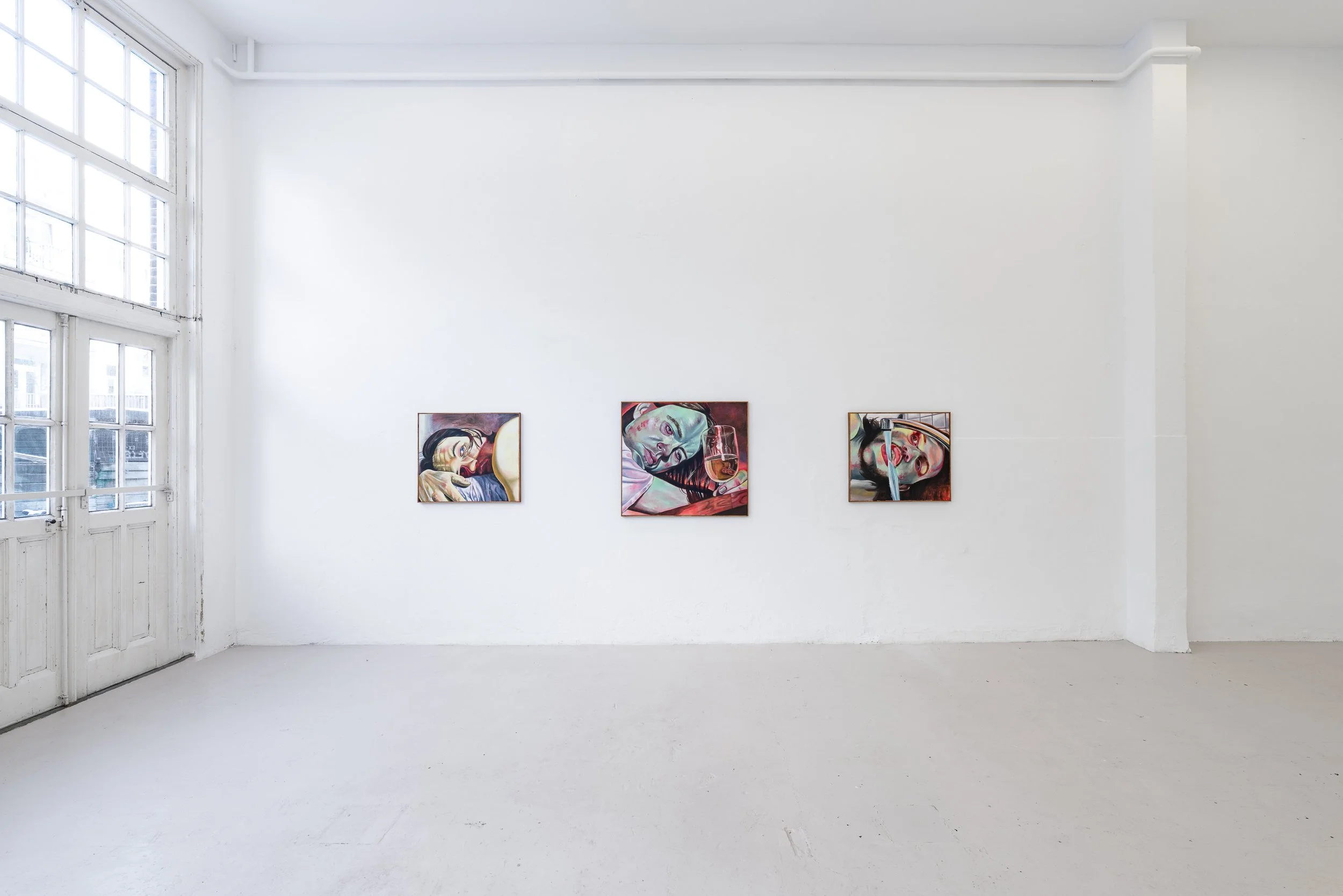
The inexplicable urge and pleasure of painting himself is perhaps best expressed in the triptych The Last Beer, The Day After #1 and The Day After #2, which can be seen in the exhibition. These are reflections on an evening when the painter drank too much and the hangover that followed. These close-up paintings are reminiscent of scenes from Billy Wilder's American film The Lost Weekend, in which actor Ray Milland struggles with alcoholism. The same exaggerated self-pity is evident, with De Vries probably enjoying painting these works as much as Milland enjoyed shooting the film.