22 October – 20 November 2022
Isa van Lier, Mirjam Vreeswijk, Natacha Mankowski
Painter's Painters
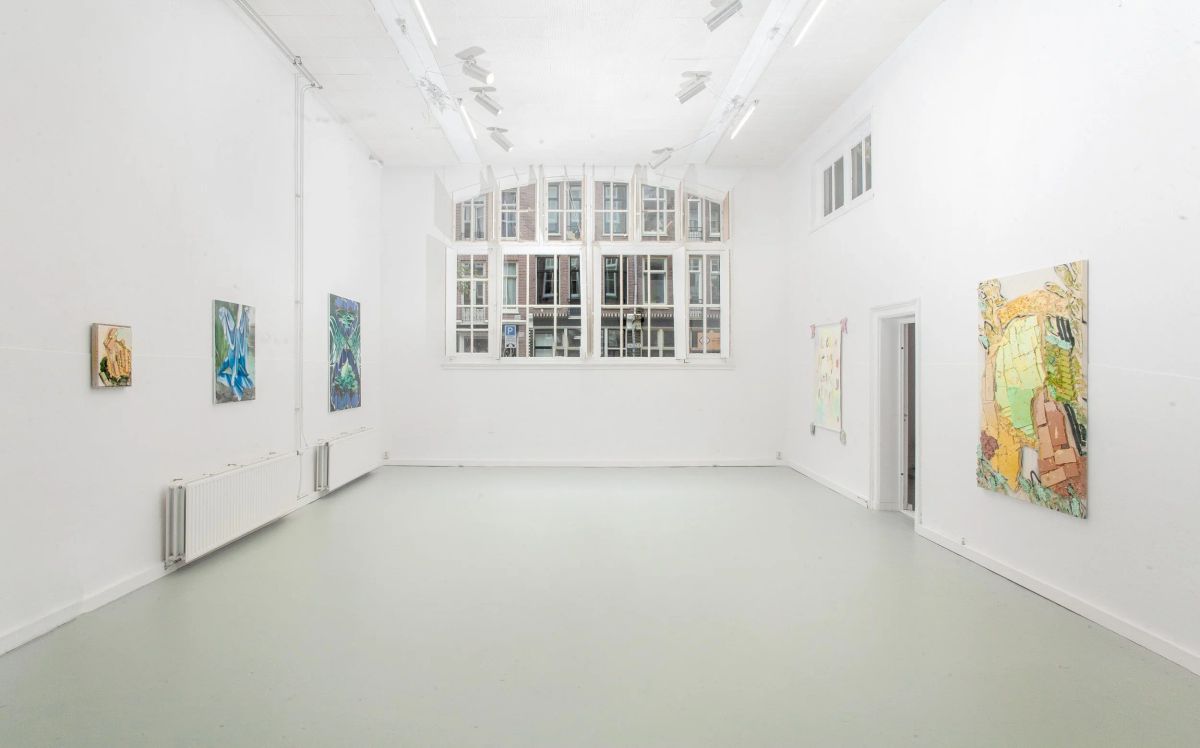
In Painter's Painters we present three painters who are exploring the medium and pushing its boundaries in different ways. Three artists known for inspiring other painters through their particular way of working: Isa van Lier, Natacha Mankowski and Mirjam Vreeswijk.
These young artists stand in the tradition of painting but use it in their non-conformist way of working. They know the technique so well that they can bend it to their will. For them, a frame is not a border or protection but part of the artwork. And they experiment with their own made paint and explore the boundaries with sculpture and architecture. They give us a glimpse of a new kind of painting.
Paintings in the realm of sculpture
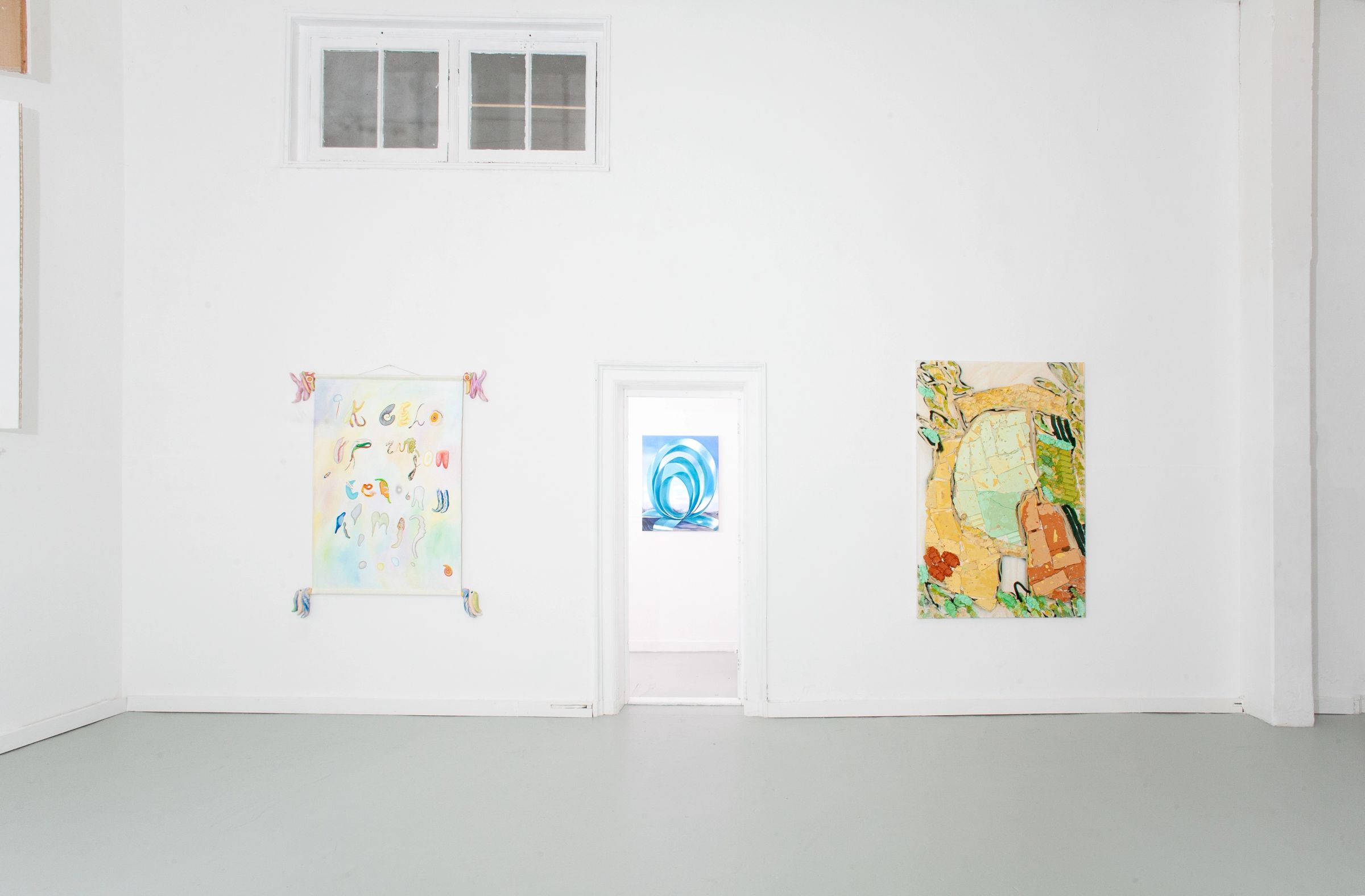
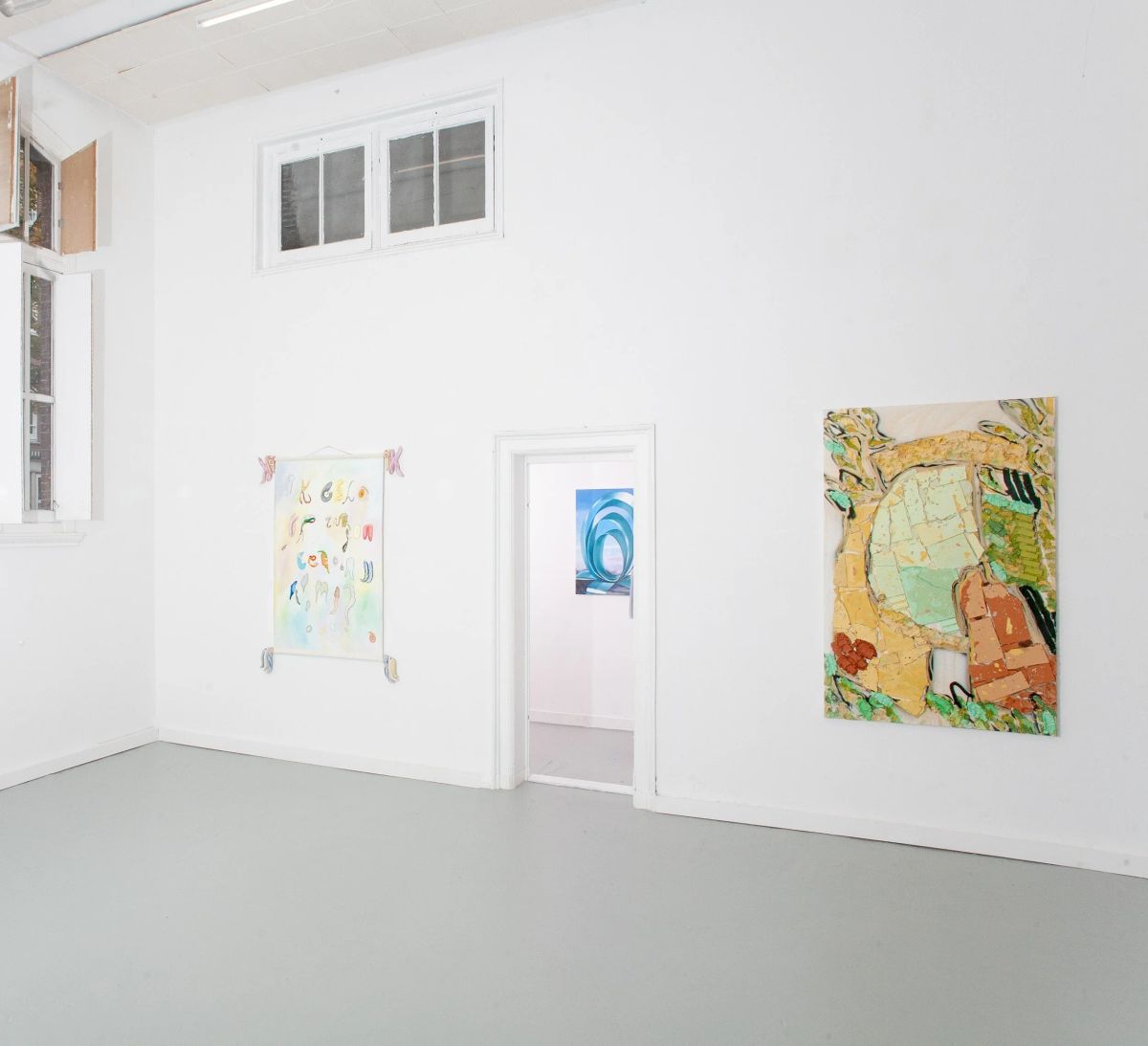
Defying the boundaries between different artistic disciplines, Natacha Mankowski’s (FR, 1986) work is characterised by an exuberant use of the impasto technique, through which she creates textural and spatial shapes that moves her paintings into the realm of sculpture. Mankowski takes a keen interest in environmental landmarks and sites such as mines or stone quarries, from which architects and builders collect their raw materials. She uses samples of these materials to create the thick impasto paint that texture her painterly work and question our relationship to the overuse of natural resources.
In this exhibition, Mankowski is showing recent work from her 'Ophite Painting' series. The works are inspired and represent the Panormos marble quarry located on the Greek island of Tinos. The marble originating from this quarry is characterised by the expressive green colour 'verde antico'. Pigments, sand, wax, oil and pebbles from the green marble that Mankowski found in the quarry found their way into the paintings in this exhibition.
Mastery of technique
Mirjam Vreeswijk (NL, 1997) uses a variety of painting techniques: taping the canvas, rubbing paint with cloths, putting glints in copper pots in which a reflection of the artist at work can be seen. They are evidence of perfect mastery of the medium. She turns these techniques to her advantage when painting her self-made collages in which reality interweaves with dream and fantasy.
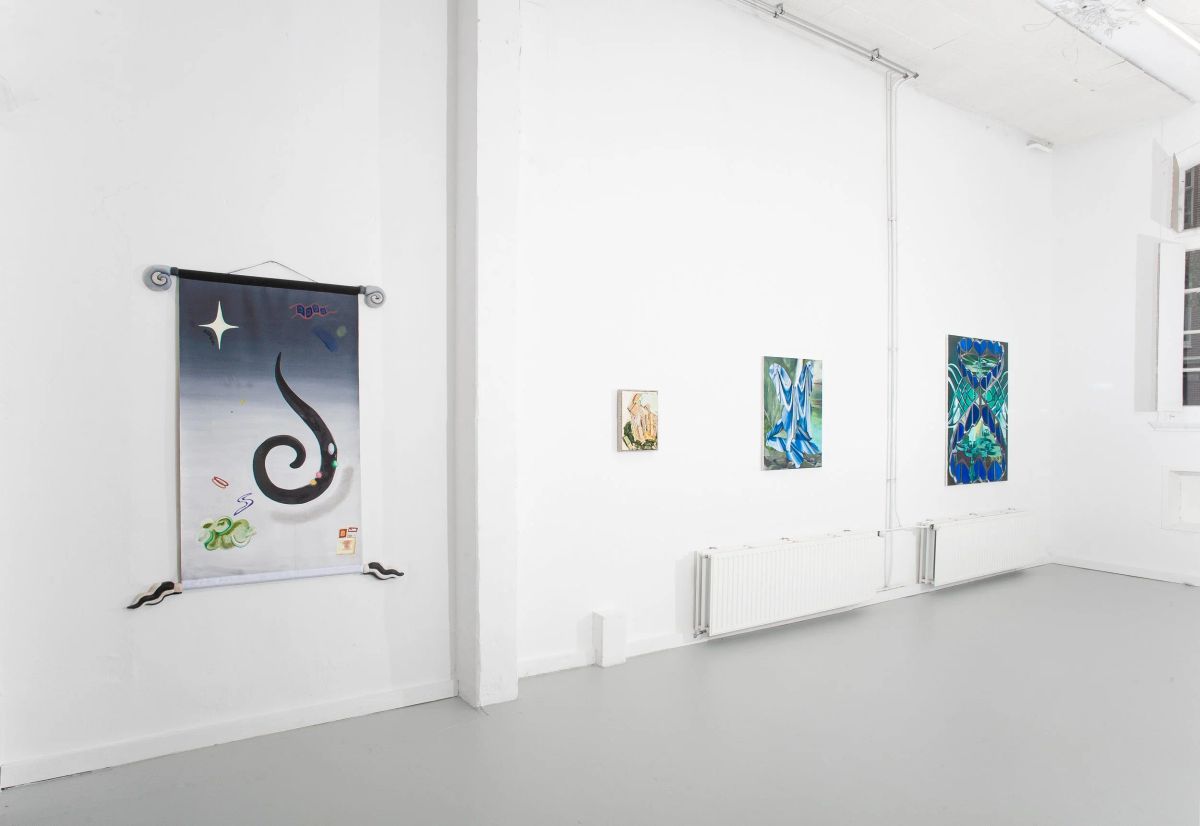
For this exhibition, Vreeswijk created a series of paintings around the theme of sets from theaters and black-and-white films. In her paintings, she always plays with what is real or an illusion, and what has depth or is actually flat. In the painting Untitled, for instance, we see a butterfly, like a set piece on stage. The insect's shape creates movement, which contrasts with the static of the set piece, as if it has the desire to fly away. The green background in her new works is reminiscent of old horror films in black and white, such as Nosferatu and Dracula. In Vreeswijk’s perception, a green haze comes over the film image, an atmosphere that appeals to her. She enhances this eerie feeling by using candles as a light source, giving the painting a great light-dark contrast which creates a dramatic effect.
Crossing the border of painting
Isa van Lier (Amsterdam, 1996) is in search of what the edges of the painting are. She does not stretch her canvases, but presents them as scrolls, with dowels at the top and bottom. For this, she looked to Japanese paintings, such as the kakejiku (掛軸, "hung scroll"). By decorating the dowels, she adds a new layer to this traditional technique. She crafts the wood, turning it into sculptures that carry the painting.
These sculptures emerge from the world she is trying to create, with its own universal visual language of shapes and colours. With this world, she immerses the viewer in wonder and brings out a childlike curiosity. The inspiration came during a stay in Japan. In particular, the country's 'kawaii' culture fascinates her: a cuteness that is visible through all layers of society. Here she was also introduced to 'shinto animism', which assumes that everything and every 'thing' has a soul. Adding faces to the shapes in her work, she applies this philosophy herself.
Her paintings themselves also show animated objects. These can be letters that come to life, as is also the case in Japanese calligraphy. Or animated forms placed very thoughtfully in relation to each other, to form a perfect harmonious image, as in a Japanese rock garden.
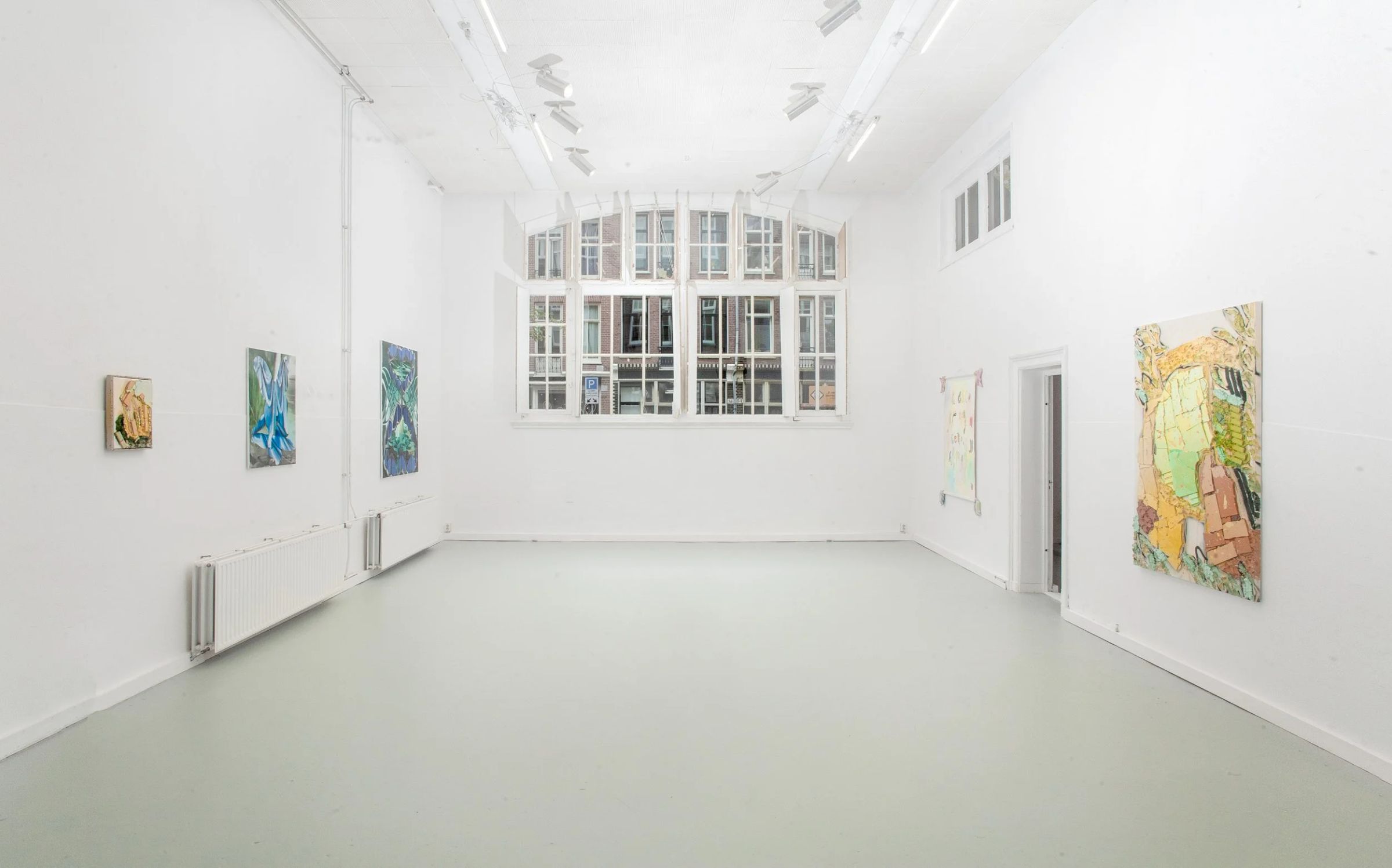
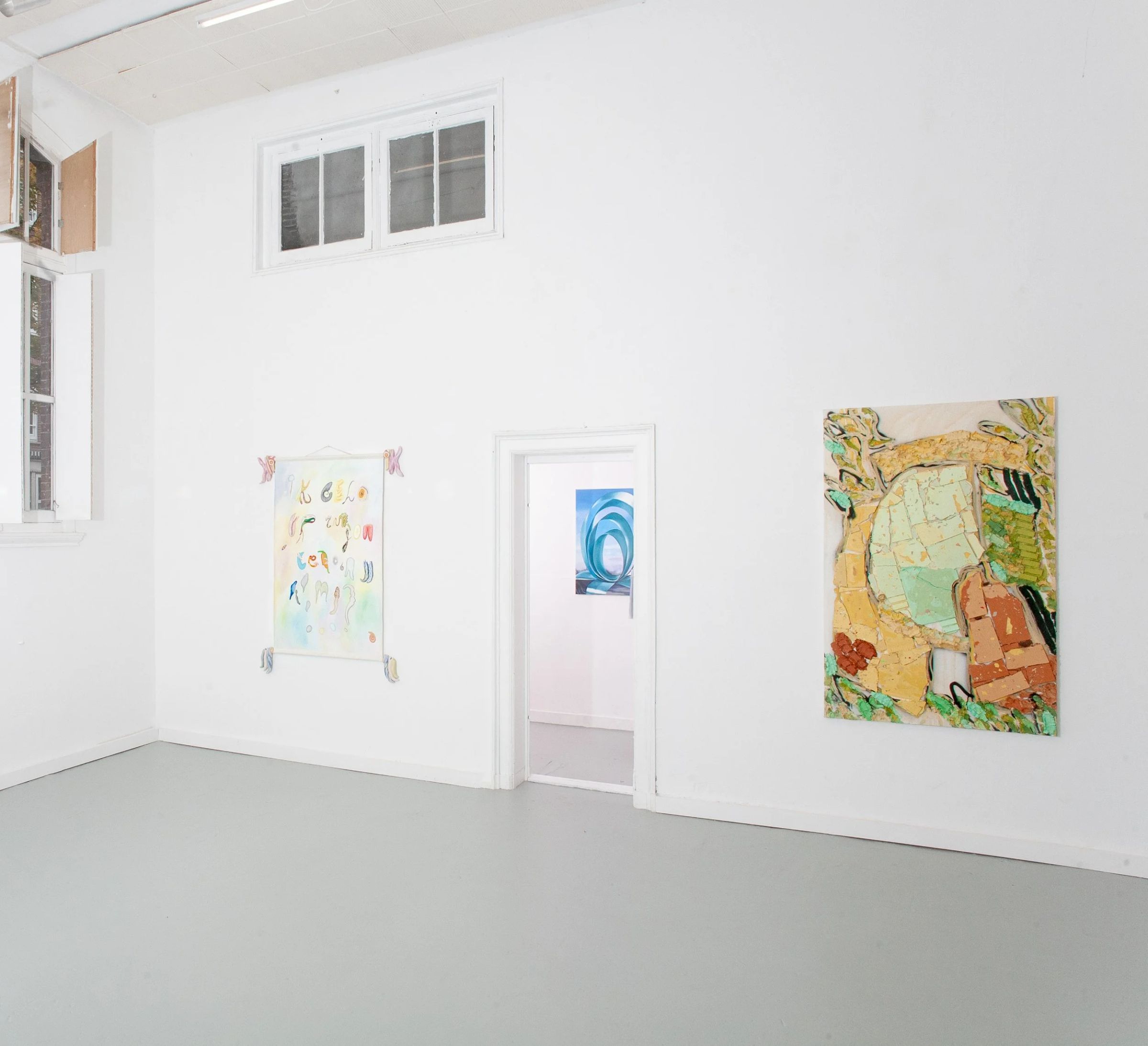
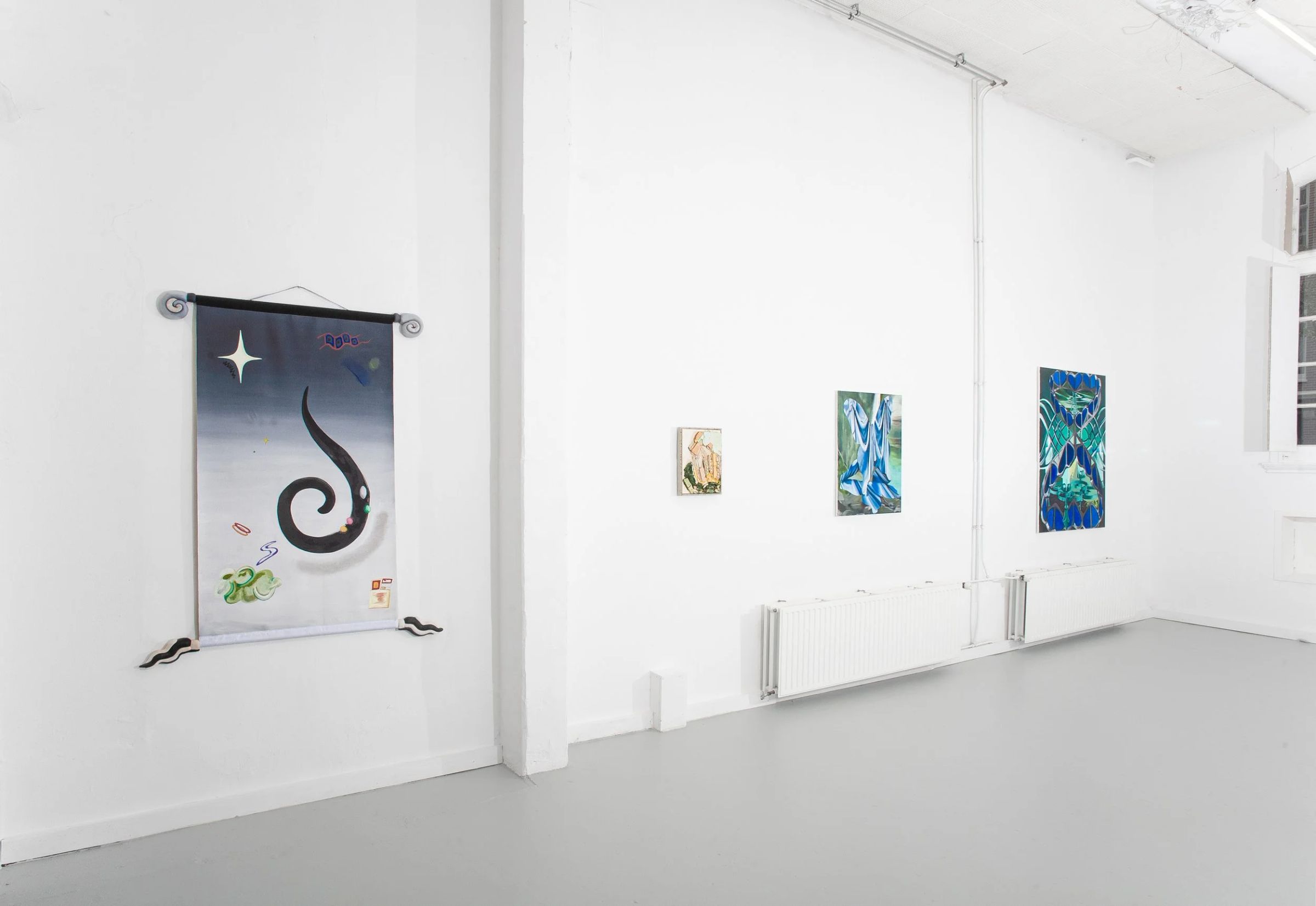
Installation views
Artists
Isa van Lier
More about Isa van Lier →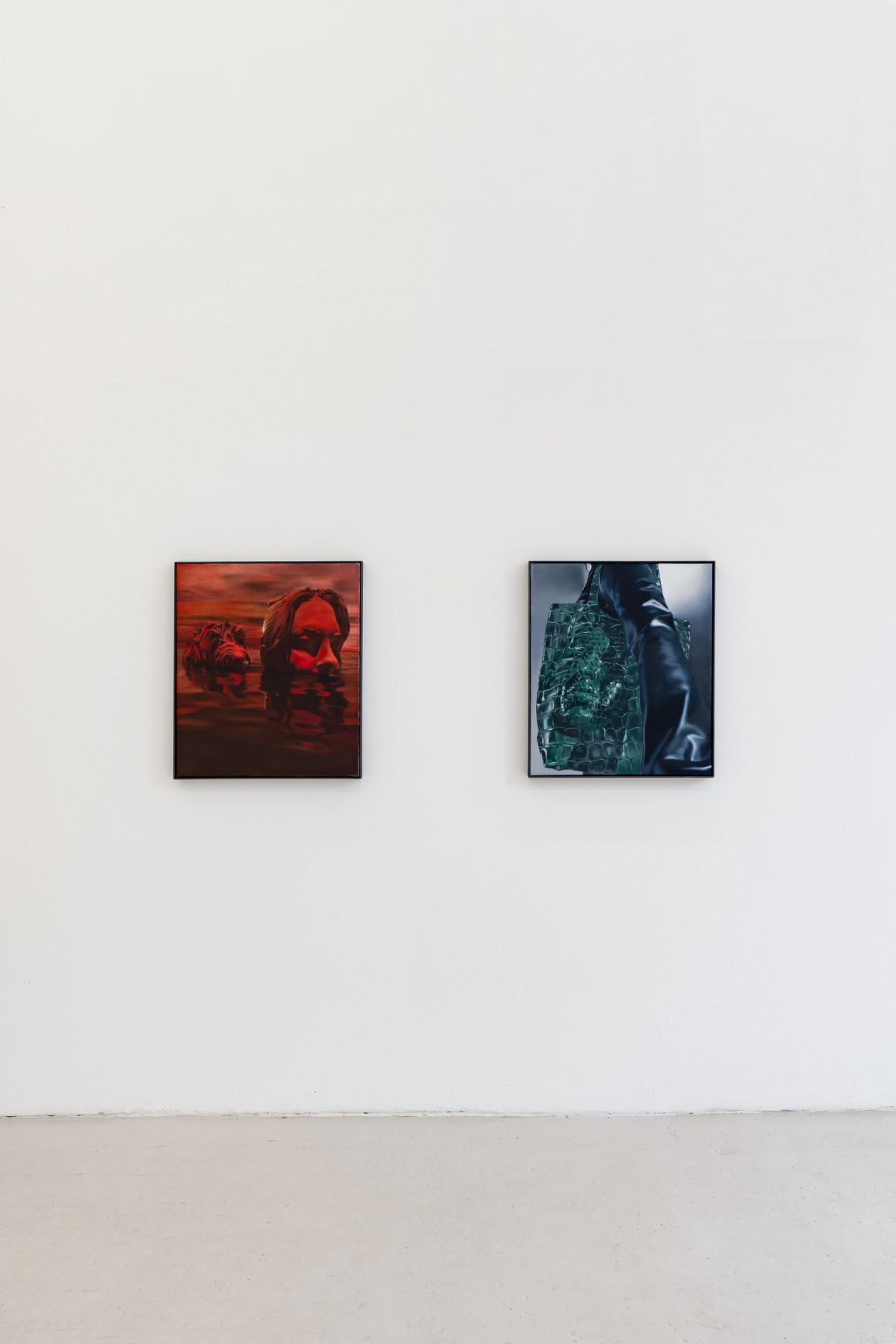
Mirjam Vreeswijk
Mirjam Vreeswijk's (Gorinchem, NL, 1997) paintings explore the convergence of divergent realities produced in a space between mirror and mask, between revealing and hiding the subject. In doing so, she seeks to draw attention to the different layers of consciousness rippling through the painting’s surface and its subject. Narrative and continuity become illusory in this hybrid space, as each work contains new perspectives that combine opposites and defy easy coherency. The work originates from collages of objects or images that appeal to her in one way or another. For example, shiny ribbons, designer shoes and pictures from books on decorative works from the 70s. From this archive of materials, she intuitively builds compositions, first in models, then on canvas. Step by step, Mirjam looks at what the image needs in order to eventually arrive at the perfect composition and perfect structures of paint. This intuitive or subconscious approach gives the paintings a surrealistic feel that touches on elements of product photography, still life and landscape painting. In her latest series the fairy-tale world makes its entrance. This can be seen in ritual objects and in the approach to landscapes that some of the paintings provide a glimpse of. After graduating in 2018 from the HKU Bachelor of Fine Art, Mirjam Vreeswijk was nominated for several awards such as the Buning Brongers Prize and the Kunst aan de dijk Prize, she won the Best of Graduates Ron Mandos Public Prize that year. She then participated in the Master Fine Art at the Frank Mohr Institute. In 2019, she was named Art Talent of the Year by Stichting Kunstweek. She has exhibited in several galleries and at Kunstcollectie Rijnstate.
More about Mirjam Vreeswijk →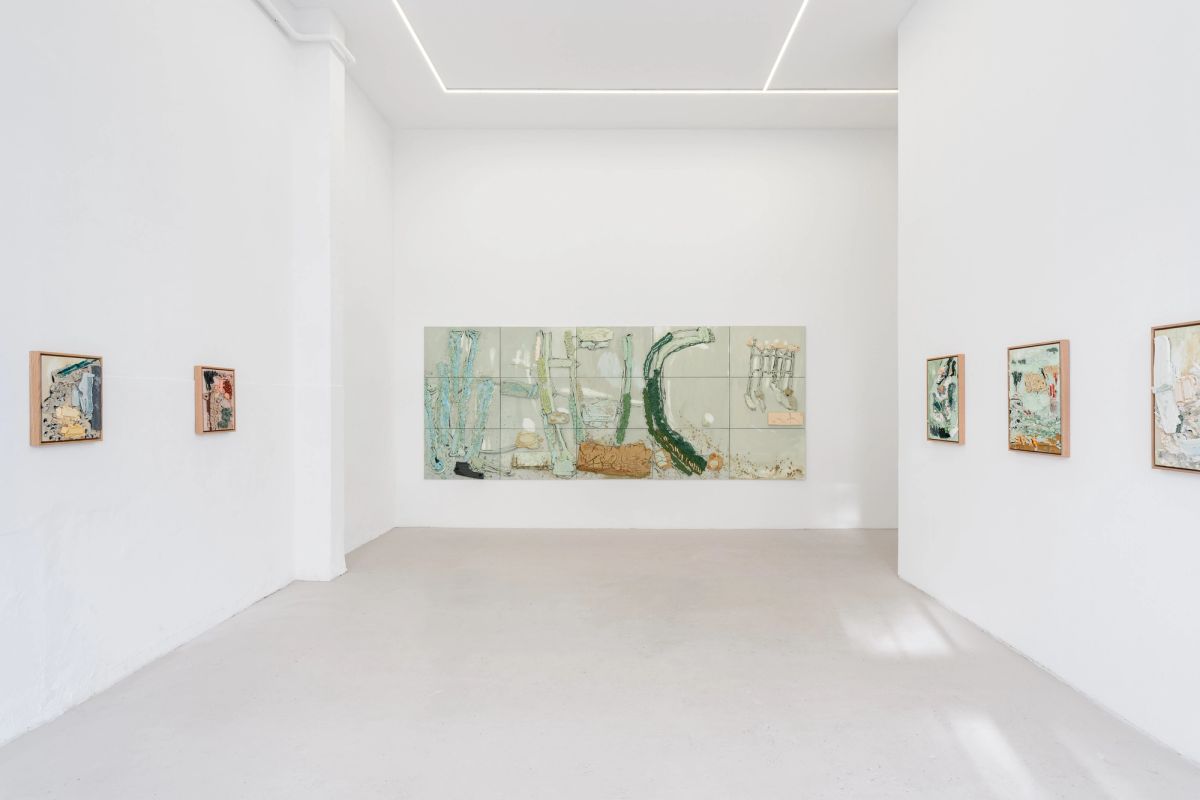
Natacha Mankowski
Trained at the École Spéciale d’Architecture in Paris, Natacha Mankowski (Paris, FR, 1986) worked as an architect alongside Jean Nouvel and Vito Acconci before turning to painting. Her architectural background still resonates strongly in her paintings. Defying the boundaries between different artistic disciplines, Mankowski’s work is characterized by an exuberant use of the impasto technique. The way she employs this technique allows her to create textural and spatial structures in her paintings that moves them into the realm of sculpture. In her new work Natacha Mankowski has intensified this spatial and sculptural effect by working with larger formats. With many of these new paintings weighing 15 to 20 kilograms and more, they acquire a singular sense of gravity and presence; indeed, these paintings are objects that themselves inhabit a space alongside the viewers. To address the question of how humans inhabit space at the intersection of nature and culture, Natacha Mankowski has developed her own visual and compositional language. While her compositions may seem abstract to the casual viewer, they are somewhat reminiscent of blueprints and ground maps widely used in architectural design and urban planning. This is no coincidence: many of her paintings are loosely inspired by the ground maps of the quarries she visited during her years as an architect. Mankowski takes a keen interest in sites such as stone quarries, from which architects and builders collect their raw materials. Midway between nature and the built environment, quarries are transitional sites in which natural resources are excavated and turned into raw commodities to be used in buildings, but also cell phones, computers, and other modern technologies. So as much as we would like to believe we are far removed from nature, through these rough materials we are intrinsically connected to it. And as such, the mines and quarries where these materials are found also raise difficult questions about how humans have turned nature into a site for commodification, a process that has brought us high-tech and the urban environment but has also triggered ecological ruin and collapse. Inspired by these issues, Mankowski has explored and visited many of these quarries, paying close attention to their geographical lay-out and the specific selection of raw materials on site. She then uses samples of these raw materials to create the thick impasto paint that texture her painterly work. Text by Bram Ieven Natacha Mankowski has exhibited in numerous international exhibitions, such as: Moly-Sabata for Biennale de Lyon, Zentrum fur Kunst ind Urbanistik (Berlin, GE) 2014 ; the Watermill Center (NY, USA) 2015, Pole muséal de Lisieux – Ateliers Intermédiaires (Lisieux, FR) 2015, Ceci Foundation (Berlin, GE) 2016, New Day Gallery (Berlin, GE) 2016, Souvenirs (Berlin, GE) 2016, the Epigraphic Museum (Athens, GR) 2018, Deschool and ISO (Amsterdam, NL), 2019, Centre d’Art Contemporain, Grenoble. She had several gallery shows at and is still working together with Everyday Gallery (2019 - 2022), Antwerp and Valerius Gallery (2022), Luxembourg City. She did a number of recidencies around the world and has been invited to teach at prestigious art schools like Sandberg Insitituut, Amsterdam. Mankowski is part of the Taylor Foundation in Paris and was the recipient of the Tony Garnier Prize, for Architecture and Urbanism awarded by the Académie Française d’Architecture in Paris.
More about Natacha Mankowski →