27 – 30 March 2025
Art Rotterdam 2025
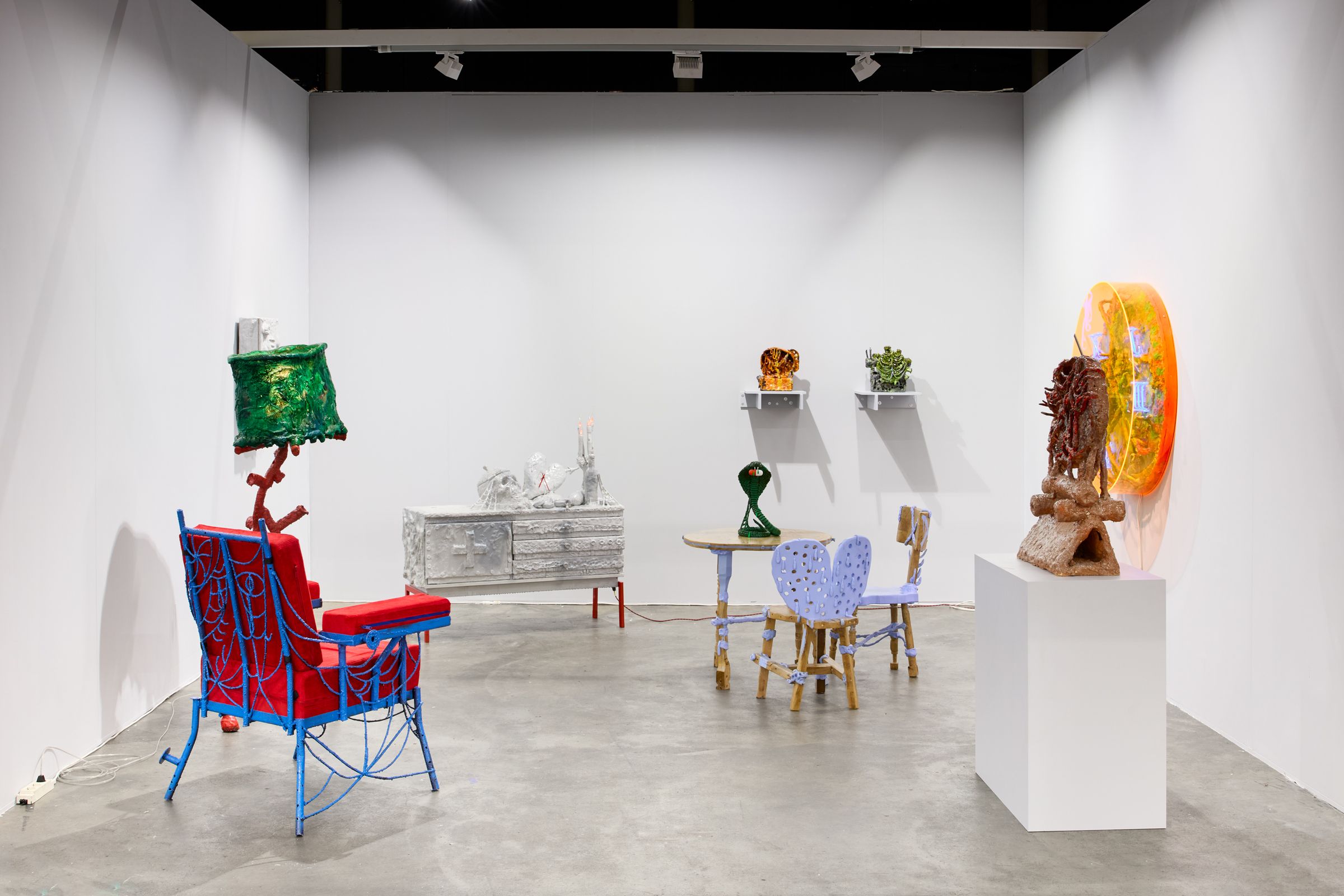
In “For Sale: My Soul (And Some Ceramics)” on view at Art Rotterdam 2025, Tom Volkaert (Antwerp, 1989) takes the familiar themes and style of his work in a whole new direction, inspired by recent events in his personal life
Volkaert's work is recognizable by its uniquely contorted, organic style and deep, saturated colours. The so-called ‘steering wheels’ that the artist is known for, are a good example. These sculptures consist of round, open circles, often the size of a steering wheel, held upright by two short legs. Volkaert found inspiration in a self-portrait that he drew in a deliberately naive, childish style. A rudimentary head and two simple legs, drawn in an unsteady hand. The erratic, jaggy lines of the drawing became the starting point for the vibrant shapes that give his sculptures their distorted but lifelike air; spread throughout the exposition, these steering wheels are like totems, remnants of creatures from another world.
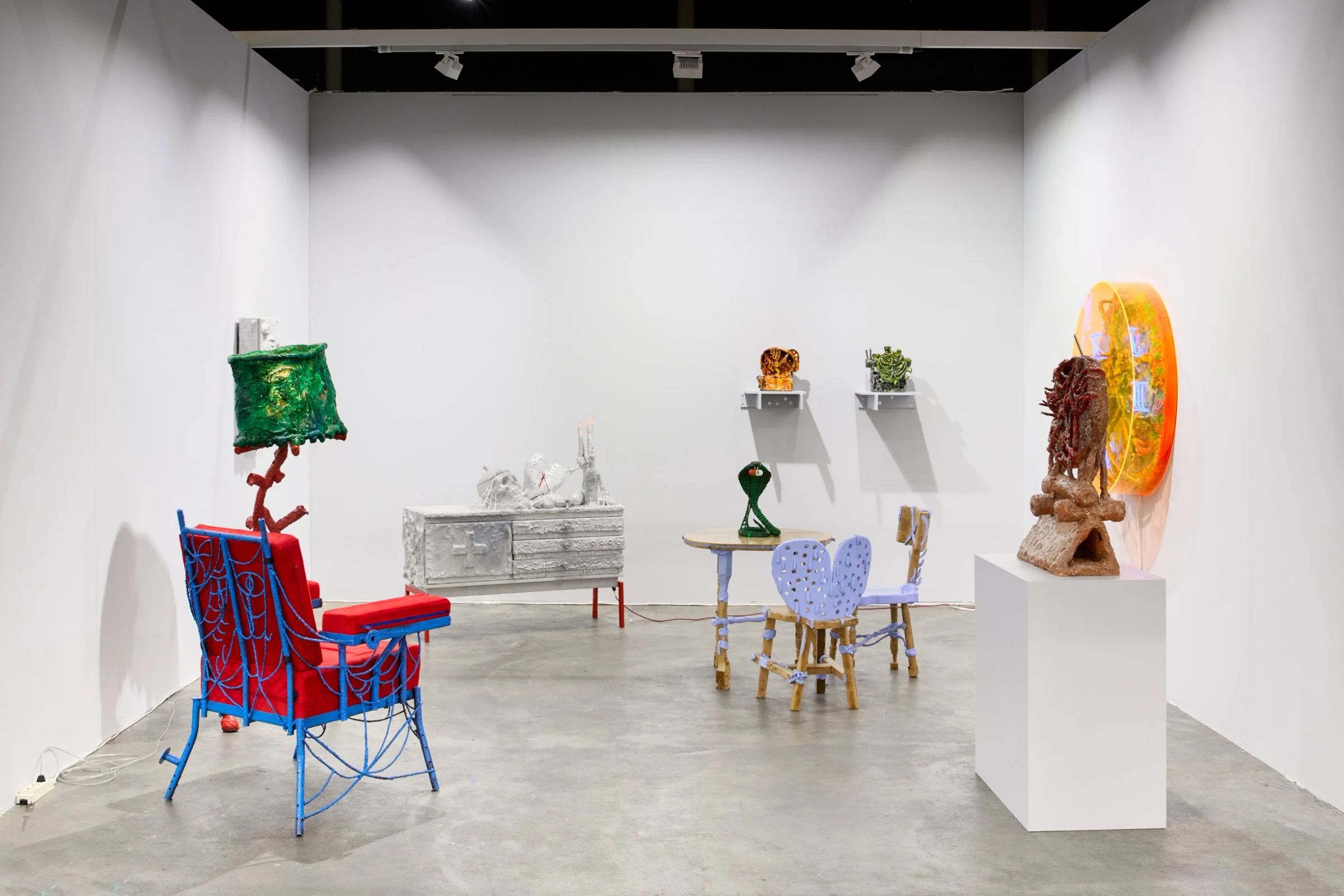
The playful approach to deeply existential themes that we find in the steering wheels is taken in a new direction in Volkaerts latest work, on display at Art Rotterdam. Volkaert’s work embraces human vulnerability, and in his most recent sculptures the artist has found new ways to engage with this theme. The inspiration came from the vanitas genre, popular in Western art during the 16th and 17th century. Like the vanitas genre, Volkaert’s new work draws inspiration from everyday house hold objects like a cabinet, a table, or a chair; and like the vanitas genre, Volkaert positions contemporary symbols on these objects that can serve as allegorical reminders of our own frailty and finitude. But Volkaert uses deeply saturated colours and a cartoonish style for these objects: a huge medication capsule, a bright pink bleeding heart, a clock, and a bottle of alcohol with the xxx that we find in cartoons…
A central work in “For Sale: My Soul (And Some Ceramics)” features a large green snake with a capsule in its mouth. Its fangs are injecting poison in the capsule. Unlike most of the other works on display, Volkaert has chosen for a realistic image of a snake. In doing so, the artist hints at the ambivalent status of a poisonous snake in popular culture: inspiring both dread and awe, the snake mirrors the role of mediation and drugs in our society, which can be both harmful and life saving.
Installation views
Artist
Tom Volkaert
Tom Volkaert’s sculptural work is a testimony to the materiality of memory as much as it is an ongoing tribute to the spiritual and shamanic force of art. Born in Antwerp in 1989, Volkaert’s sculptural work is a carefully balanced combination of refined artistic craftsmanship and the strategic use of unpredictability that comes into play when working with enameled ceramics, epoxy, or oxidized metal. Many of his works consist of circles on legs, which the artist likes to call steering-wheels. These works are like totems: symbolic and organic artifacts that make present the otherworldly alien life in the cosmos and that put us in touch with something radically different from us. On the edges and inside these circles, contorted arachnoid limbs, intestines, and sickly satanic tongues are carefully arranged and held in suspended animation. It is as if these circles are portals to another cosmic dimension and something wholly other than human life is trying to get through, a lumpy otherworldly and alienated organic gesturing at us in a way that feels both familiar and estranging. But Volkaert’s so-called steering wheels are also a totem for his own life and memories, a way of navigating and coming to terms with his own life. For Volkaert, colors embody memory. Personal memories first of all. And thus, the lived memory of the cinereous cigarette stains on the caput morteem colored carpet in his parent’s living room is reenacted and relived through the use of these colors in his work. But universal memories too. The usage of umbilical greyish pink and placenta-colored red appeal to a birthing process all of us have gone through; engaging with these colors, Volkaert’s sculptures establish a connection to the matrixial mother in which all creativity is situated, making the viewer receptive to the most intimate and estranging experience of being alive. Conjuring up these contradictory feelings and holding them together is, ultimately, at the core of Volkaert’s artistic practice. Holding together contradictory sensations, his art opens a space where feelings of joy, surprise, wonder, and disgust are enclosed in the same ceramic totem or metal cut-out or epoxy statues. Text : Bram Leven
More about Tom Volkaert →